If you are searching for the best CRM for a window treatment business, you may already know that keeping track of leads, customers, appointments, quotes, and follow-ups can become complicated quickly. A customer relationship management system can help organize those interactions, but for a window treatment retailer, CRM functionality is only one piece of a much larger workflow.
Window treatment businesses do more than manage contacts and sales opportunities. They measure windows, build detailed quotes, manage product options, place orders, track jobs, schedule installations, collect payments, communicate with customers, and market to new and past clients.
That is why the best CRM for a window treatment business may not actually be a standalone CRM at all.
Instead, retailers should consider how customer relationship management fits into the entire process of running their business—from the first lead to the final installation and beyond.
MyBlindCo was built specifically for the window treatment industry with that bigger picture in mind. Rather than trying to make a general-purpose CRM fit a highly specialized business, MyBlindCo combines industry-specific business software with integrated tools and services designed around how window treatment professionals actually work.
What Does a CRM Do for a Window Treatment Business?
CRM stands for customer relationship management. At its core, a CRM helps a business organize information about prospects and customers and keep track of interactions throughout the sales process.
For a window treatment retailer, that might include keeping track of:
- New leads and their contact information
- Phone calls, emails, and text conversations
- Appointments
- Sales opportunities
- Quotes that require follow-up
- Customer history
- Notes and internal communication
- Follow-up tasks
- Past customers who may purchase again
Those capabilities can be extremely valuable. Without a central system, important information can easily become scattered across email inboxes, phones, calendars, spreadsheets, notebooks, and individual employees.
The best CRM for a window treatment business should make it easier for everyone involved in the sales process to understand where a customer stands and what needs to happen next.
But there is an important limitation to consider.
Most traditional CRM platforms were designed to manage sales relationships across many different industries. They were not built around measuring windows, configuring window treatments, preparing product-specific quotes, ordering from manufacturers, or managing installations.
For window treatment retailers, those processes are not separate from the customer relationship. They are the customer relationship.
Why a Standalone CRM May Not Be Enough
Imagine a new lead contacts your business about replacing the shades throughout their home.
A CRM may be able to capture the customer’s name, phone number, email address, and lead source. It may also help you schedule an appointment and remind your salesperson to follow up.
But what happens after that?
Your team still needs to measure the windows. You need to select products and options, calculate pricing, prepare the quote, send it to the customer, collect a deposit, submit an order, monitor the order, schedule installation, collect the remaining balance, and maintain a record of the project.
If those steps require multiple disconnected systems, your CRM may organize the lead without actually organizing the business.
That distinction matters when evaluating the best CRM for a window treatment business.
Instead of asking only, “Which CRM has the most features?” a better question may be:
Which system supports the complete workflow of my window treatment business?
What Should Window Treatment Retailers Look for in CRM Functionality?
CRM functionality still plays an important role. The difference is that it should work alongside the rest of your business rather than becoming another isolated system.
Here are some of the most important capabilities to consider.
Centralized Customer Information
Customer information should be easy to find.
Your team should not have to search through several systems to determine who a customer is, what they purchased, whether they received a quote, or what happened during the last interaction.
Centralizing information can make it easier for salespeople, office staff, managers, and other team members to stay on the same page.
Lead and Opportunity Tracking
New inquiries should have a clear path through the sales process.
A strong CRM workflow helps you identify new leads, see which prospects have been contacted, monitor scheduled appointments, and determine which opportunities are still active.
This becomes particularly important as a business grows. A salesperson may remember five active prospects. Remembering dozens or hundreds of opportunities—and exactly when each one needs attention—is much harder.
Follow-Up Management
One of the biggest advantages of CRM technology is consistency.
A potential customer may not be ready to purchase immediately. Someone who received a quote may need another conversation before making a decision. A previous customer may be interested in another room or another property months later.
The best CRM for a window treatment business should help your team stay connected without relying entirely on someone remembering to send the next email or make the next call.
Communication History
Knowing what has already happened is just as important as knowing what needs to happen next.
Being able to reference customer communication can reduce confusion, particularly when multiple employees interact with the same customer.
Appointment Management
Appointments are a major part of the window treatment sales process. CRM and calendar functionality should make it easier to manage upcoming appointments and keep customer information connected to the sales process.
Automation
Automation can help retailers create more consistent processes.
For example, automated follow-ups can help businesses continue communicating with leads and customers based on where they are in the sales process.
The goal is not to replace personal service. It is to reduce the manual work required to make sure important communication does not get forgotten.
The Best CRM Should Connect to Your Quoting Process
This is where the needs of a window treatment business begin to differ significantly from those of many other industries.
Quoting is a central part of selling custom window treatments.
A salesperson may need to work with dimensions, products, fabrics, colors, control types, mounting options, upgrades, motorization, installation charges, and numerous other variables.
Using one system to manage the customer and another completely separate system to prepare the quote can create unnecessary duplication.
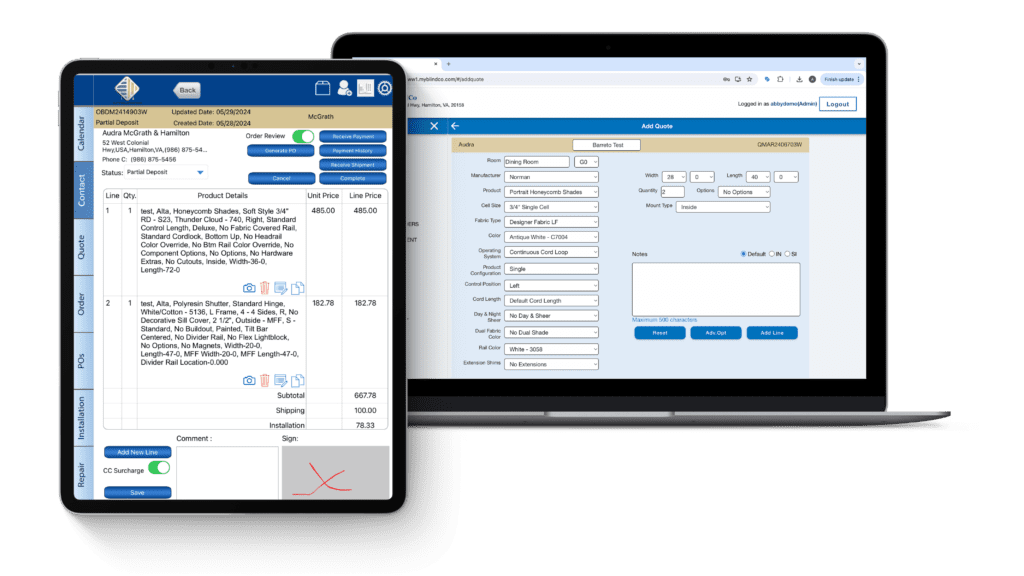
MyBlindCo was designed specifically for window treatment professionals, including the quoting process that takes place every day in the field.
Retailers can create quotes using industry-specific software rather than attempting to adapt a generic sales platform to a specialized product.
That is an important consideration when searching for the best CRM for a window treatment business: what happens when the conversation with the customer turns into an actual quote?
Think Beyond CRM: From Quote to Order
Winning the sale is not the end of the workflow.
Once a customer approves a quote, the business needs to turn that sale into an order.
That transition can become a source of inefficiency when customer management, quoting, and ordering are handled in different places.
Employees may find themselves copying information from one platform into another, checking multiple systems, or manually updating the status of a project.
Industry-specific business software can create a more connected path from quote to order.
MyBlindCo helps window treatment retailers manage the process beyond basic customer relationship management, including quoting, electronic ordering, order tracking, and other operational tasks.
The value is not simply having more software features. It is having capabilities designed to work together around the same job.
Order Tracking Matters Too
Once products have been ordered, customers naturally want to know what happens next.
Has the order been placed? Has it arrived? Is the installation ready to schedule?
Your team needs visibility as well.
Order tracking helps employees understand the status of jobs without relying on scattered notes or individual employees to provide updates.
When considering the best CRM for a window treatment business, look beyond what happens before the sale. Consider how easily your team can follow the customer and their project after the deposit has been collected.
A complete customer experience extends all the way through installation.
Business Management Should Be Part of the Conversation
CRM software generally focuses on customer interactions and sales activity. Window treatment retailers also need tools to manage the broader business.
That can include reporting, payments, calendars, orders, sales activity, and other operational information.
When those tools are disconnected, owners and managers can spend significant time assembling information from different sources just to understand what is happening in their business.
A more integrated approach can provide better visibility while reducing unnecessary administrative work.
MyBlindCo includes business management capabilities specifically for window treatment professionals, helping retailers manage more of their day-to-day operation through one industry-focused platform.
Don’t Forget About Working in the Field
Window treatment sales do not happen exclusively behind a desk.
Retailers and salespeople regularly meet customers at project locations, take measurements, discuss product choices, and prepare quotes while away from the office.
That makes mobility an important consideration when evaluating the best CRM for a window treatment business.
A platform designed for the industry should reflect the realities of working in the field.
MyBlindCo supports the window treatment sales process on mobile devices, including the ability to work with quoting and customer information while meeting with customers.
The goal is to make technology fit the way your team already works—not force your team to reshape its sales process around generic software.
What About Marketing?
Generating and managing leads is another area where a basic CRM may only solve part of the problem.
A CRM can help organize a lead after that person enters your system. But where did the lead come from? What happens if the person does not schedule immediately? How do you request reviews from customers? How do you stay connected with previous customers?
These questions move beyond basic contact management and into marketing.
MyBlindCo offers marketing solutions alongside its core business software, giving window treatment companies access to tools and services designed to help generate, nurture, and retain customers.
Automated Follow-Ups
Consistent follow-up is one of the clearest opportunities for automation.
MyBlindCo’s my5starz platform can support automated follow-ups and customer communication, helping retailers continue engaging leads and customers based on their stage in the process.
That can help reduce the chance of a valuable opportunity disappearing simply because the next follow-up was forgotten.
Review Requests
Online reviews play an important role in local visibility and consumer decision-making.
Building review requests into a repeatable process makes it easier to ask satisfied customers for feedback rather than relying on employees to remember every time a project is completed.
Email and SMS Communication
Different situations call for different forms of communication.
Email and text messaging capabilities can help businesses stay connected with prospects and customers throughout the relationship.
Staying Connected With Past Customers
A completed installation does not necessarily mean the customer relationship is finished.
Previous customers may have additional rooms, second homes, commercial properties, referrals, or future window treatment needs.
An effective system should help retailers maintain those relationships over time.
CRM and Lead Generation Are Different Problems
There is another distinction worth making.
A CRM helps you manage leads. It does not necessarily generate them.
If your primary challenge is getting more prospective customers in the first place, CRM software alone is unlikely to solve the problem.
That is why MyBlindCo’s broader approach also includes digital marketing services for window treatment businesses.
Depending on a company’s needs, that can include services such as search engine optimization, Google Ads, social media, websites, local search strategies, and other marketing initiatives.
For retailers evaluating the best CRM for a window treatment business, it is worth considering both sides of the equation:
How will we generate opportunities, and how will we manage them once they arrive?
Solving only one side can still leave a major gap.
Integration Can Be More Valuable Than Having More Features
Software comparisons often turn into feature checklists.
Does Platform A have this feature? Does Platform B have that one?
Features matter, but integration matters too.
A business can subscribe to a CRM, quoting program, scheduling application, payment processor, email marketing system, review platform, reporting tool, and several other services—and still have an inefficient workflow.
The problem is not necessarily that any individual program is bad.
The problem is that employees become responsible for connecting everything manually.
They may enter the same information more than once. They may forget to update one system. Important context can live in one platform while another employee is working somewhere else.
The best CRM for a window treatment business should therefore be evaluated based on how well it fits into the rest of the company’s workflow—not simply on how impressive its CRM feature list appears.
Generic CRM vs. Window Treatment Business Software
A generic CRM can be a good choice for many companies, particularly businesses with relatively straightforward sales processes.
Window treatment retailers have a more specialized workflow.
A typical project may involve:
- A new lead entering the business.
- Initial communication with the prospect.
- Scheduling an appointment.
- Measuring windows.
- Selecting products and options.
- Creating a detailed quote.
- Following up on that quote.
- Collecting a deposit.
- Converting the sale into an order.
- Ordering products.
- Tracking incoming products.
- Scheduling installation.
- Completing the installation.
- Collecting final payment.
- Requesting a review.
- Staying connected for future business.
CRM functionality is important throughout that process—but it is not the entire process.
That is why industry-specific technology can offer an advantage.
Instead of starting with generic CRM software and building workarounds for everything else, retailers can use software designed around the way window treatment companies operate.
Questions to Ask When Comparing CRM Options
Before choosing software, consider how it would function during an ordinary day at your company.
Ask questions such as:
- Can we easily keep track of leads and customers?
- Can we see where opportunities stand in the sales process?
- Can our team manage appointments?
- Can we automate appropriate follow-up?
- Can we communicate with customers efficiently?
- Can we prepare window treatment quotes within the same broader workflow?
- Can we turn those quotes into orders?
- Can we electronically order products?
- Can we track orders and job progress?
- Can our salespeople use the system while working in the field?
- Can we accept payments?
- Can management access useful business reporting?
- Can we stay connected with previous customers?
- Can the system support review generation and marketing?
- How many separate programs will employees still need to use?
- Was the platform actually designed for the window treatment industry?
The answers will tell you much more than a simple list of CRM features.
What Is the Best CRM for a Window Treatment Business?
Ultimately, the best CRM for a window treatment business is one that supports the way your company sells, communicates, and operates.
For some businesses, a standalone CRM may be enough.
For window treatment retailers looking to connect customer management with quoting, ordering, scheduling, payments, business management, and marketing, however, a broader industry-specific platform may make more sense.
That is the distinction behind MyBlindCo.
MyBlindCo is not simply a CRM for window treatment companies. It is an all-in-one software, marketing, and manufacturing solution created specifically for the window treatment industry.
Its retailer software is designed to support the workflow from customer and appointment management through quoting, ordering, order tracking, reporting, and payments. Marketing solutions add capabilities for lead management, automated follow-ups, reviews, digital marketing, and ongoing customer communication.
And because MyBlindCo is built specifically for window treatment professionals, retailers are not starting with generic business software and trying to make it understand their industry.

One Platform Built Around the Window Treatment Industry
Choosing business software should not be about adding another login to your technology stack.
It should be about making the entire operation easier to manage.
CRM functionality is an important part of that. But so are quoting, orders, appointments, payments, marketing, follow-up, reporting, and the dozens of steps that take a project from an initial inquiry to a completed installation.
If you are comparing the best CRM for a window treatment business, consider whether you really need another CRM—or whether your business would benefit from a platform built to connect more of the workflow.
MyBlindCo brings industry-specific software, marketing, and manufacturing capabilities together in a solution built by window treatment professionals who understand the challenges of running a window treatment business.
See How MyBlindCo Fits Your Business
Every window treatment company operates a little differently. The best way to evaluate software is to see how it would fit into your actual sales and operational process.
Schedule a custom MyBlindCo demo to see how MyBlindCo can help your window treatment business manage customers, create quotes, process orders, track jobs, streamline everyday operations, and stay connected with leads and customers—all through technology built specifically for the window treatment industry.
Comments are closed